ERP Selection: The Most Capable Solution Isn’t Always Preferred
During a technology selection process, organisations typically assess functionality, technology, implementation approach, total cost of ownership, vendor references and other factors intended to test whether a proposed option can deliver the desired outcome. Evaluation criteria and weightings are normally agreed in advance to support a fair and objective assessment.
The expectation is that this assessment will identify the "correct" option. Yet many organisations reach the end of the exercise and still find themselves debating the decision. Why does this happen, and what should they do about it?
Context: Building a Credible Longlist
It is worth stepping back and looking at how a typical technology selection process unfolds.
Before detailed assessment begins, organisations should already have narrowed the market to a longlist of potential solutions and implementation partners. Longlisting is often driven by desktop research, market knowledge and initial vendor engagement, with additional information obtained through a formal Request for Information (RFI) where required.
The purpose of the longlist is not to identify a preferred solution, but to establish a credible set of candidates worthy of further consideration whilst avoiding unnecessary effort for both the organisation and prospective suppliers.
Only those with a realistic prospect of delivering the project objectives should progress to the shortlist and detailed evaluation.
Evaluating Capability
Functional fit, technical suitability, delivery feasibility, commercial viability and the organisation's broader requirements and constraints all form part of the assessment. For the purposes of this article, I will refer to this collective view as capability.
The detailed evaluation of capability for the shortlisted candidates is intended to answer two related questions:
Can this option deliver the project objectives with an acceptable level of risk, cost and complexity?
How does it compare to the other viable options under consideration?
The assessment is designed to compare competing options on a consistent basis, allowing the project team to understand both relative strengths and potential weaknesses.
The purpose of detailed evaluation is not simply to score options, but to validate capability and expose potential “red flags”. For example, a solution that initially appeared attractive may only be able to satisfy a critical requirement through significant customisation, despite the project's stated intention to adopt a fit-to-standard approach.
This approach removes unsuitable options from consideration. Whilst each of the remaining solutions may have different strengths and weaknesses, all represent a potential path forward for the organisation.
The project team can then rank the shortlisted options against the agreed criteria and present its recommendation to the steering group or leadership team.
Sometimes the recommendation is straightforward. One option is clearly ahead of the rest, the decision is widely supported and the organisation moves forward. But not every selection is that clear-cut.
Beyond Capability
Even after a rigorous evaluation, leadership teams will sometimes challenge the outcome, ask additional questions or express reservations about the recommended option.
This can be frustrating for those involved in the assessment. Considerable effort has been invested in creating an objective process. Requirements have been defined, weightings agreed, responses reviewed and assumptions tested.
If the evaluation has been completed properly and the recommendation is clear, why is there still a discussion?
It is because leadership is often considering an additional question: Are we confident enough in this option to live with the consequences of that decision for years to come?
Assessing Confidence
Unlike capability, confidence cannot be reduced entirely to numbers. It is developed through reference conversations, market knowledge and direct engagement with the organisations involved. It is an informed judgement, built through evidence, interaction and experience.
By the time a recommendation reaches the steering group or leadership team, decision-makers should have had sufficient opportunity to develop their own informed view of the organisations behind those options.
Most vendors welcome these opportunities. They are often keen to engage directly with leadership teams, explain their vision, discuss business outcomes and demonstrate how they would support the organisation beyond software implementation. These conversations provide an opportunity to build confidence in the relationship as well as the solution.
Executive presentations, strategy discussions, reference site visits and leadership-to-leadership conversations can all play a role. These interactions are not intended to revisit functional requirements or technical architecture. Their purpose is different. They help leadership understand how potential strategic partners think, how they approach risk, how they respond to challenge and whether their vision aligns with the organisation's own objectives.
Capability and Confidence in Practice
Rather than mapping confidence into a score and combining it with the capability assessment, my preferred way to think about this is to plot the remaining shortlisted options on a simple chart. By separating the two dimensions, leadership can openly discuss how much confidence it has in the preferred option and why, rather than hiding that judgement within a weighted score.
A fictional example is shown below:
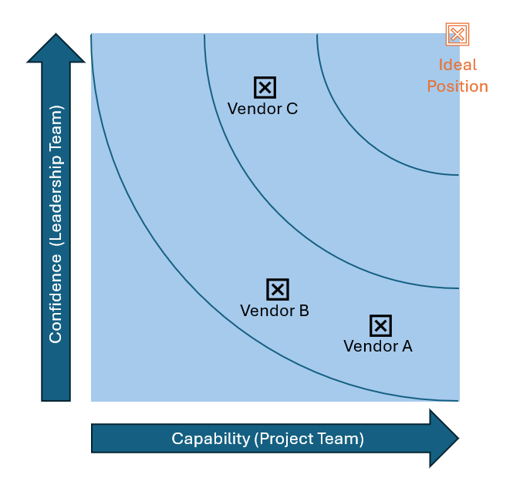
Using capability alone, Vendor A would be preferred because it achieved the highest evaluated capability score during the formal assessment process.
When leadership confidence is considered alongside capability, the picture changes. Vendor C remains capable of meeting the organisation's requirements but also enjoys the highest confidence amongst the leadership team regarding the software, implementation partner, delivery approach and long-term outcomes.
In this example, Vendor C would be the preferred vendor. Whilst not ideal, it combines sufficient capability with a high level of leadership confidence and therefore sits closest to the ideal position in the upper-right corner of the model.
A Note of Caution
This model should not be interpreted as a simple calculation for selecting a vendor.
The model is intended to complement, not replace, the formal evaluation process. Its purpose is to make explicit a discussion that is often happening anyway. Ultimately, the outcome will be influenced by how capability and confidence are valued by the organisation, which in turn defines the scales used on the axes above.
As discussed in my previous article on leadership alignment, the most important conversations are often those that help decision-makers understand what they collectively value and why. The same principle applies here. The model does not produce the answer; it helps structure the discussion that leads to it.
Leadership Commitment
Technology selection is not simply a procurement activity. It is one of the first stages of organisational change.
The project team helps the organisation understand the available options and their implications. Leadership decides which future it is prepared to commit to.
Change frameworks such as Prosci's ADKAR begin with Awareness and Desire. Before an organisation can successfully adopt a new solution, its leaders need to understand why change is necessary and genuinely believe in the future being proposed.
This is why confidence matters. Leadership is expected to sponsor the programme through difficult decisions, competing priorities and inevitable project challenges. Confidence in the selected solution helps create the belief and commitment needed to sustain that sponsorship.
Capability without confidence creates risk. Confidence without capability creates limitations. Successful ERP projects require both.
If your organisation is preparing for ERP or business systems selection, a conversation with Goodison Advisory can provide an independent perspective to help build a credible longlist, evaluate capability, challenge assumptions and support leadership alignment around the preferred vendor.
A successful selection process does more than rank capable solutions. It helps leadership make an informed decision and commit to a future that it believes in.
Comments